
Our Lady of Walsingham
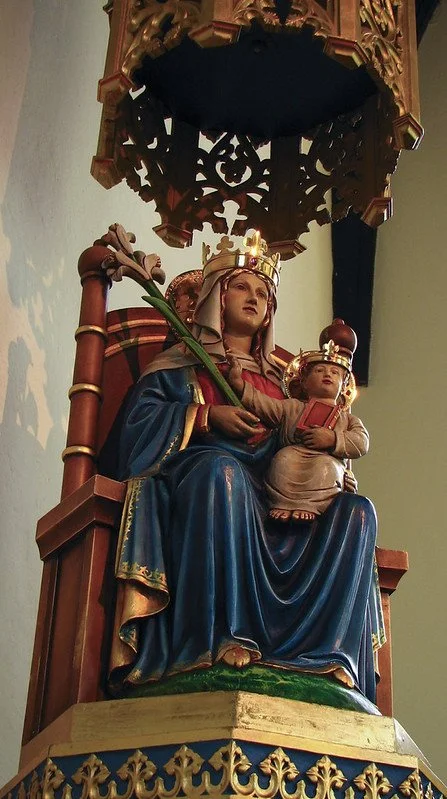
Image: photo by Fr Lawrence Lew on Flickr
The earliest image of what the original statue of Our Lady of Walsingham looked like appears on the seal of the original Priory. All modern statues of Our Lady of Walsingham have been based on this. The image of Our Lady of Walsingham seems to be part of a school of statues, ‘Crowned Virgin’ or ‘Crowned Virgin-Mother’ statues found all over Europe, showing Mary seated on a throne, a Seat of Wisdom. In such statues she is the crowned Virgin-Mother. But, notice, too, that not only is Mary enthroned; Christ is enthroned on her knee. So, she herself becomes the Seat of Wisdom: hence why these statues are also known as ‘Seat of Wisdom’ statues. Mary is no longer the lowly maid from Nazareth, “for he that is mighty hasmagnified me’. ‘The Almighty has done great things for me.” She is the crowned Virgin-Mother, an Empress, enthroned, holding her Son. The maid of Nazareth has become a powerful and majestic figure, and her power, deriving from her Motherhood, is evident in her powerful intercession with her Son.
There are three features, not found on any other statues, which make her rather unique:
Firstly, there are seven rings on the sides of her throne, three on one and four on the other. Since the original statue is dated early in the thirteenth century, they may stand for the seven sacraments. It is more likely, however, that they pick up the Wisdom theme and the scriptural gifts of the Holy Spirit.
The second feature of the medieval image of Our Lady of Walsingham, which makes her unique, is not unconnected with Solomon’s Temple. On the Priory seal are what seem like two looped curtains around the statue. They are not merely decorative drapes, but represent the veil of the Temple torn in two, at the moment Our Lord died on the cross.
The third unique feature, often not reproduced on modern statues, we learn from Erasmus, who came on pilgrimage to Walsingham in 1512. He tells us that beneath the feet of the Virgin was what the French called a toadstone, a green jewel on which was imprinted a toad. On being asked in his colloquy why they attach a toad to the Virgin, Erasmus explains, ‘because all filthiness, malice, pride, avarice, and whatever belongs to human passion, has been by her subdued, trodden underfoot, and extinguished. In the Book of Genesis, in the Garden of Eden, God says to the serpent, “I will put enmity between you and the woman, and between your seed and her seed; he shall bruise your head, and you shall bruise his heel.” But the iconography goes back to the vulgate mistranslation, which reads, not He but “She will crush your head, and you will lie in wait for her heel.” In England, we don’t have many snakes, but we do have toads.